
Housing Resources for Homeowners and Renters in Southeastern Connecticut
Overview
The resources on this page were prepared specifically for homeowners and renters in the region. You’ll find information that supports residents in accessing housing options, like building an accessory dwelling unit, information on where to find affordable rental units, and similar. Use the Resource Links table to the right to navigate to the subject that interests you.
Resource Links
Building an Accessory Dwelling Unit
Inventory of Dwellings with Affordability Controls
Building An Accessory Dwelling Unit (ADU)
ADU Basics – What is an ADU and where do you start?
Placeholder Text
ADU Regulations in the SECOG Region by Town
Placeholder Text
SECOG’s engagement Approach and Timeline
The Act sets deadlines for specific activities. July 1, 2026 is the deadline for municipalities to adopt mandatory zoning changes (further described below). SECOG has until June 1, 2027 to finalize the Regional Housing Needs Assessment / Recommended Municipal Affordable Housing Goals. Towns must decide to opt-in to the regional HGP or pursue a stand-alone local HGP by July 1, 2027. All HGPs in the SECOG region are due June 1, 2028. SECOG aims to complete the goals-setting process by March 2027 to provide municipalities more time to deliberate on opting in to the regional HGP process.

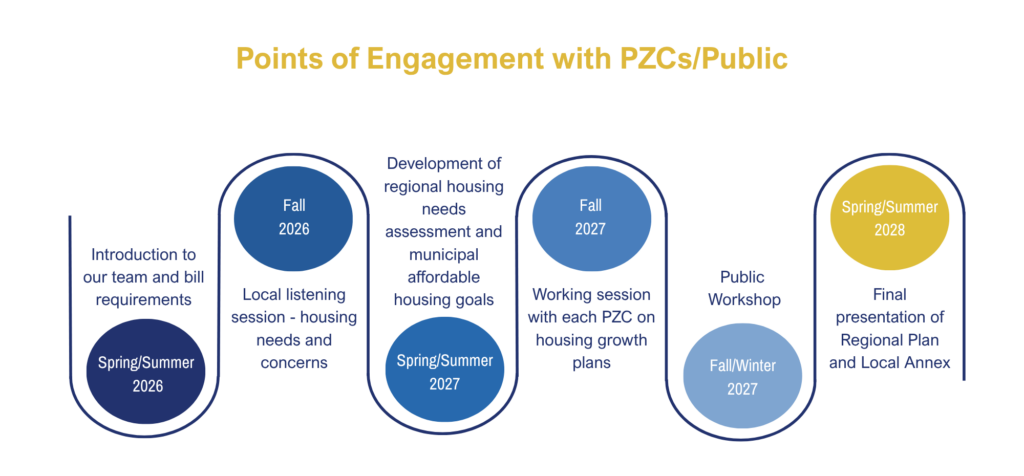
In addition, SECOG has a plan for points of engagement with member municipalities throughout this first HGP process. In spring and summer 2026, SECOG had introductory meetings on the Act in each town with the Planning and Zoning Commission and Chief Executive Officer. Next, SECOG will ask to return to each town two more times for decision makers opt in to the regional plan or pursue an independent path. For towns that opt in to the regional plan, SECOG staff are planning three additional points of engagement.
Zoning Changes
Middle Housing Project Approvals via Summary Review
Effective July 1, 2026, municipalities must now allow “transit community middle housing” (buildings with two to nine dwelling units) or mixed-use development on any lot zoned for commercial or mixed-use development. These projects are subject only to summary review.
Per summary review, if proposed subjects (1) comply with applicable zoning regulations, and (2) do not substantially impact public health or safety, municipalities must approve projects and may not require a public hearing or other discretionary approval for such developments.
Parking Requirements
SSPA 25-1 amends the zoning enabling statute to generally prohibit land use commissions from regulating parking minimums, except for:
- Developments of 17 or more units: Municipalities may require minimum off‑street parking for developments containing 17 or more dwelling units at a rate of 1 space for studios and one-bedroom units and 2 spaces for units with two or more bedrooms.
- Conservation and Traffic Mitigation Districts: Municipalities may designate up to two Conservation and Traffic Mitigation Districts and require minimum off-street parking for developments of all unit counts (including 16 units or fewer). Each district may not exceed 4% of the municipality’s land area, although the districts may be contiguous.
In all cases and even within these exceptions, developers must also be allowed to submit a Parking Needs Assessment to demonstrate that fewer spaces are necessary. For developments of 17 or more units and commercial developments, developers may pay a fee in lieu of constructing the required parking. A municipality may only accept such a fee only if the required parking would result in an excess of unnecessary spaces or cannot physically be accommodated on the property, and any fees collected must be used solely for specific, transportation-related services.
Mobile Manufactured Homes
The Act eliminates the former 22‑foot width requirement for manufactured homes. Municipalities may not impose conditions or requirements on manufactured housing that substantially differ from those applied to other residential uses, provided the homes are constructed in compliance with applicable federal standards.
Other Provisions
Sections 1-3: First-Time Homebuyer Savings Program
Sections 1-3 of the legislation establish a First-Time Homebuyer Savings Program. It defines a first-time homeowner as “an individual who did not own or purchase, individually or jointly with another person, a one-to-four family residence prior to the closing date of a real estate transaction involving the purchase of a one-to-four family residence in this state by the individual.” Eligible individuals can open first-time homeowner savings accounts, which the individual and their employer may contribute to. Funds from this account may be used for the down payment and closing costs for a one-to-four family primary residence.

Sections 32 & 35: Renter Protections and Assistance
Section 35 expands the list of municipalities that must establish or join a Fair Rent Commission from municipalities with 25,000 residents to 15,000. Municipalities with a population of 15,000 or more must participate in either a Municipal Fair Rent Commission, Joint Fair Rent Commission (consisting of two or more bordering municipalities), or a Regional Fair Rent Commission (established by the COG). New SECOG municipalities impacted by this legislation are Colchester, East Lyme, Ledyard, Montville, Stonington, Waterford, and Windham. These communities must establish participation by January 1, 2028.
To further support renters, the act also bans the use of rent-setting technology by landlords.

Sections 11-13: Transit-Oriented Development
Sections 11-13 state that municipalities may decide to become a transit-oriented community (TOC) by adopting a Transit Oriented District (TOD) and meeting certain transit requirements (Ex. Rapid transit station, bus services, etc.). TOCs may be eligible for financial incentives through PA 25-1, including Housing Growth Program funds, sewer improvement loans, etc. It is important to note that municipalities may adopt a TOD, while not being recognized as a TOC.
TODs must meet certain requirements and permit certain residential uses as of right. The areas must support higher density, meet community housing needs, allow for conversion of commercial to residential use as or right, and more. If a municipality establishes a TOD, property owners within the district who have owned their property for three or more years are permitted to build an accessory apartment as of right. These requirements are designed to increase housing stock adjacent to public transportation to facilitate its use, reduce car dependence, improve accessibility, and encourage mixed-use development.
Section 26: Addressing Homelessness
PA 25-1 Section 26 prohibits municipalities from installing new Hostile Architecture; design features used to prevent homeless individuals from sitting or lying in a public space. Existing hostile architecture must be removed if the municipality receives a written complaint.
A new pilot program was also established to support individuals experiencing homelessness. The state will provide portable shower and laundry facilities to a minimum of three municipalities. In January 2027, a report will be submitted to the General Assembly on the program’s success.
State Funding for Housing Related Development
Under this act, the Office of Policy and Management (OPM) must establish a housing growth program no later than July 1, 2028. The program will provide grants-in-aid to municipalities to support housing-related costs such as construction and public infrastructure projects. Additional state funding will be provided to municipalities for school construction and water quality projects for sewer or conveyance system improvements. These funding programs are unlocked with various required provisions (e.g. Housing Growth Plans) and/or optional provisions (e.g. designation as a Transit-Oriented Community or having a CDMA Development District).
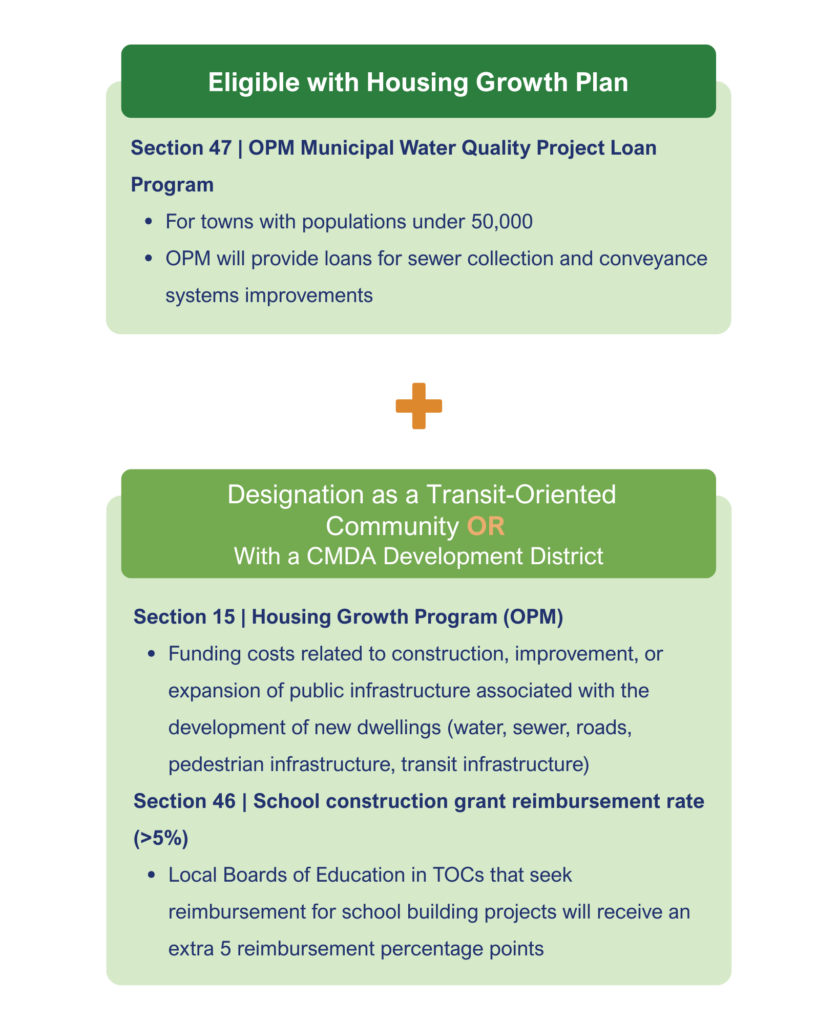
Additional grants are authorized to COGs, housing authorities, and municipalities to advance middle (medium-density) housing, the revitalization of vacant commercial property, public transportation infrastructure, and other development initiatives. Moreover, starting June 1, 2026, the open choice school program will be applicable to all districts, rather than only Hartford.
