
SECOG awarded grant from EPA for Brownfield assessments
We are proud to announce that SECOG, in partnership with the Eastern CT Land Bank (ECLB) and CT Resource Conservation and Development Area (CT RC&D), has been awarded $1.2 million through EPA’s Brownfield Assessment Coalition Grant Program to support environmental assessment, community engagement, and redevelopment planning in Preston, Windham, and Sprague.
Working closely with project partners, municipal leaders, community members, and property owners, we anticipate these environmental assessments and strategic reuse planning efforts will help bring long-dormant properties back into active use.
Learn more about the grant in SECOG’s press release, as well as on EPA’s website. We look forward to sharing more details as this project moves forward.
What Happens after the bin?
Once trash and recyclables are thrown into their respective bins and then hauled away at the curb or taken to a transfer station, it can be easy to think that our collective household waste is “out of sight, out of mind.”
But our trash has to go somewhere and once it leaves homes, schools, and businesses it undertakes quite a journey to different final destinations: stored permanently in a landfill, burned for energy, or recycled into reusable materials (compost, metals, papers, etc.).
SECOG recently hosted a regional Solid Waste Facility Bus Tour to give local leaders a closer look at the lifecycle of everyday waste and recycling. Mayors, first selectmen, public works directors, and other municipal staff toured WIN Waste’s Waste-To-Energy facility in Lisbon, Casella’s Materials Recycling Facility (MRF) in Windham, and Ledyard’s Transfer Station Food Waste Collection to learn more about how our region is working to manage waste in a more economically and environmentally sustainable way.
WIN Waste-to-Energy
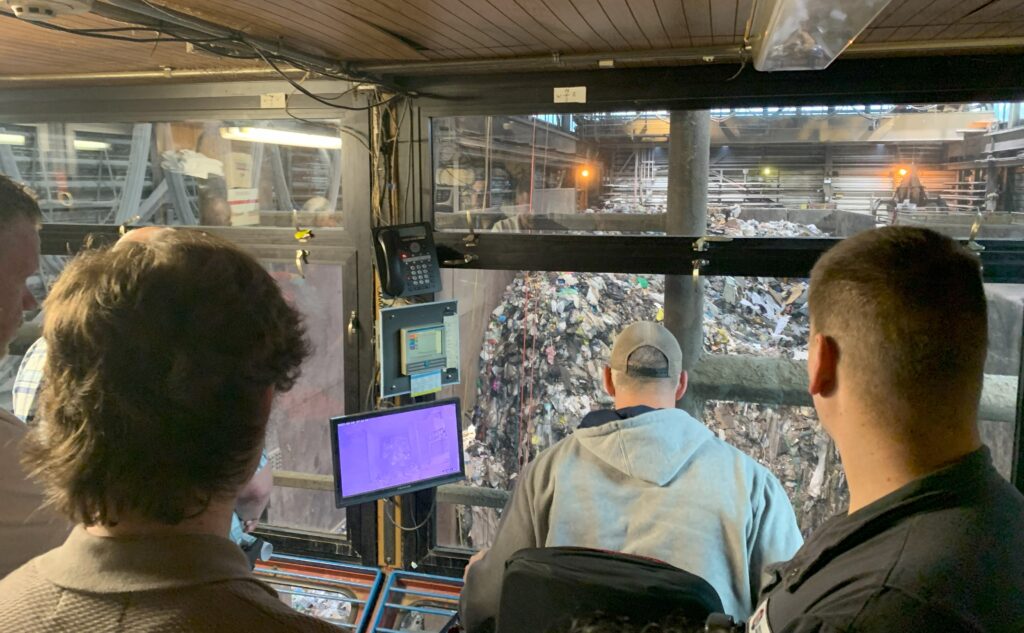
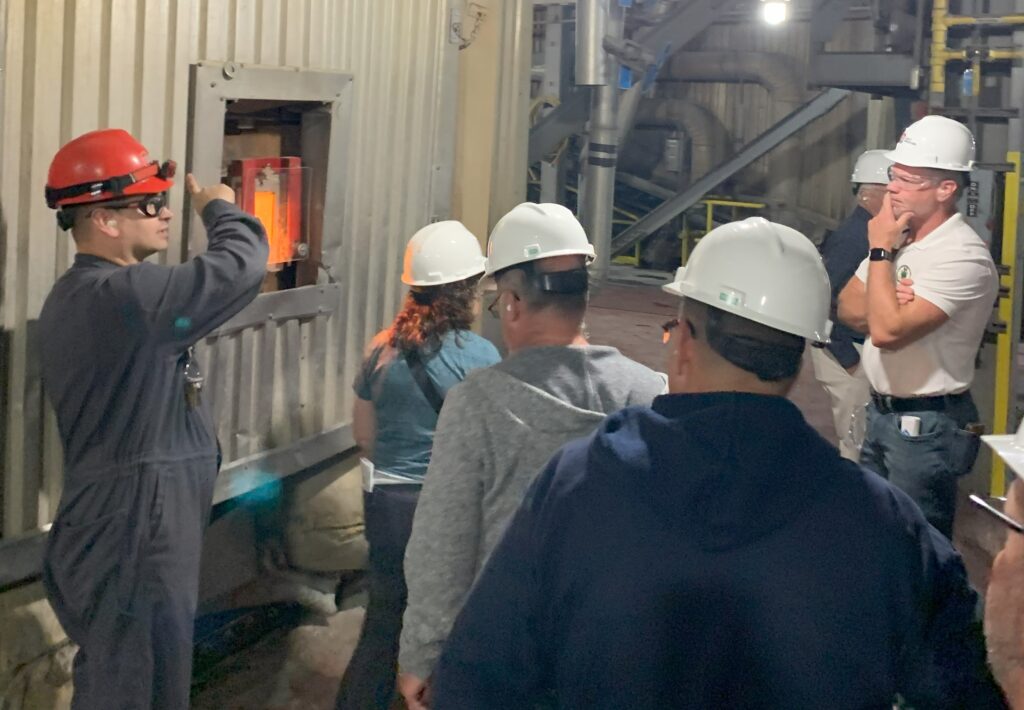
At the waste-to-energy facility, trash is first sorted by the operator of a giant claw into smaller piles by their wet-to-dry material ratios, which determines how they are burned. Items that cannot be burned can also be identified and removed during this process.
These piles are then burned via an efficient combustion system that uses Continuing Emission Monitoring that samples the flue to ensure compliance with the facility’s air quality permits. Data is summarized every minute, hour, and 24 hours. The facility mitigates several environmental concerns: nitrogen oxides, which produces smog, are reduced by injecting urea into the furnace; mercy emissions are absorbed through the use of activated carbon; acid gasses are removed by injecting lime slurry into the flue gas; and a fabric filter removes particulate matter from the flue gas.
The WIN Waste facility processes 184,000 tons of refuse each year, which is the smallest amount among the state’s 4 waste-to-energy facilities.
Casella Materials Recovery Facility
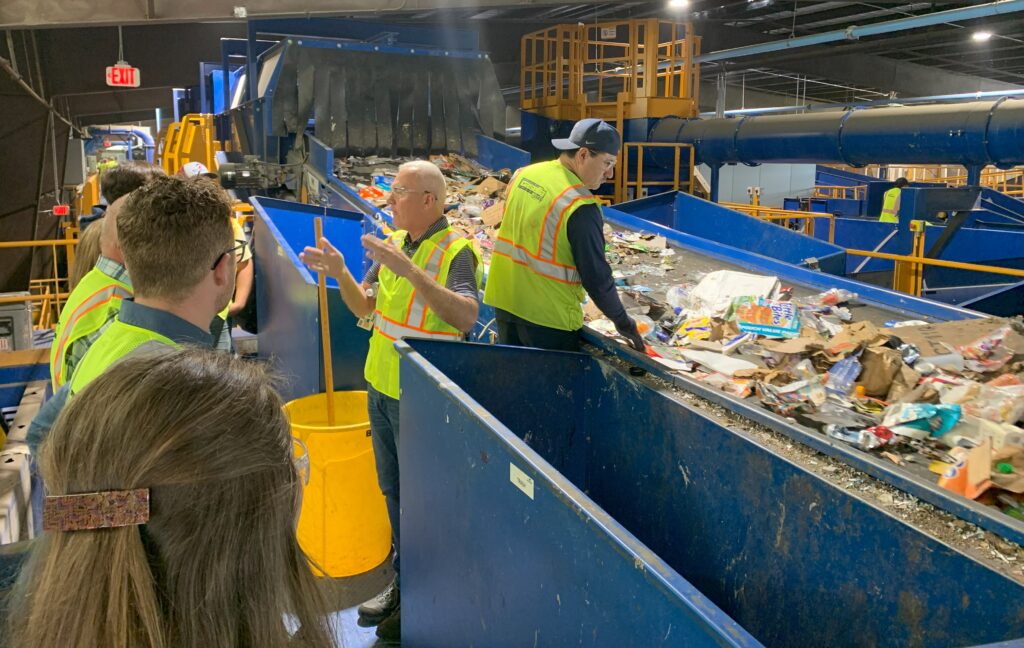
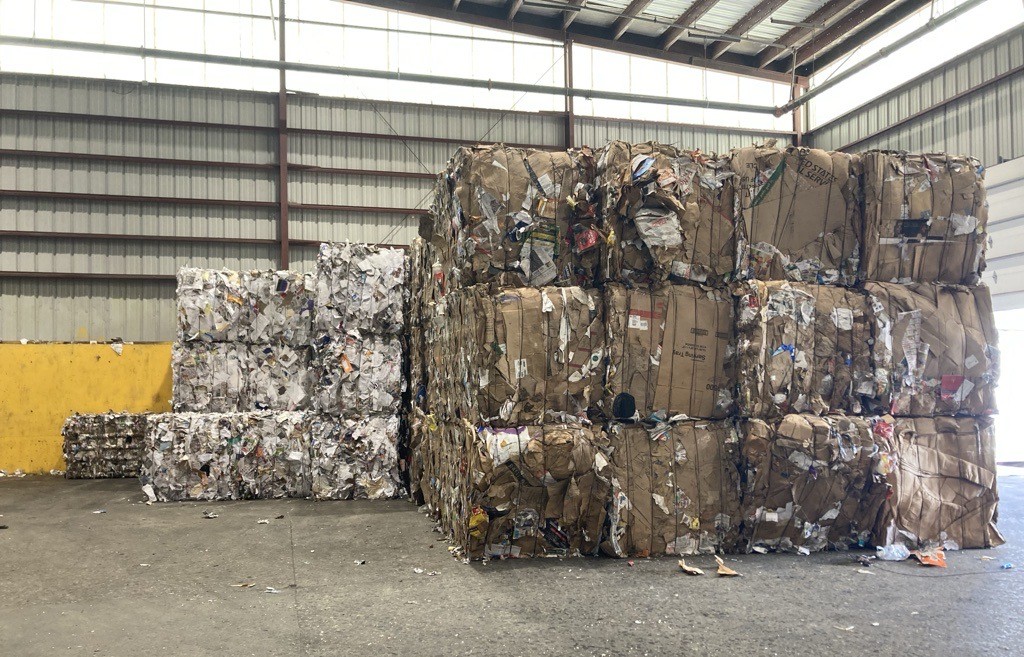
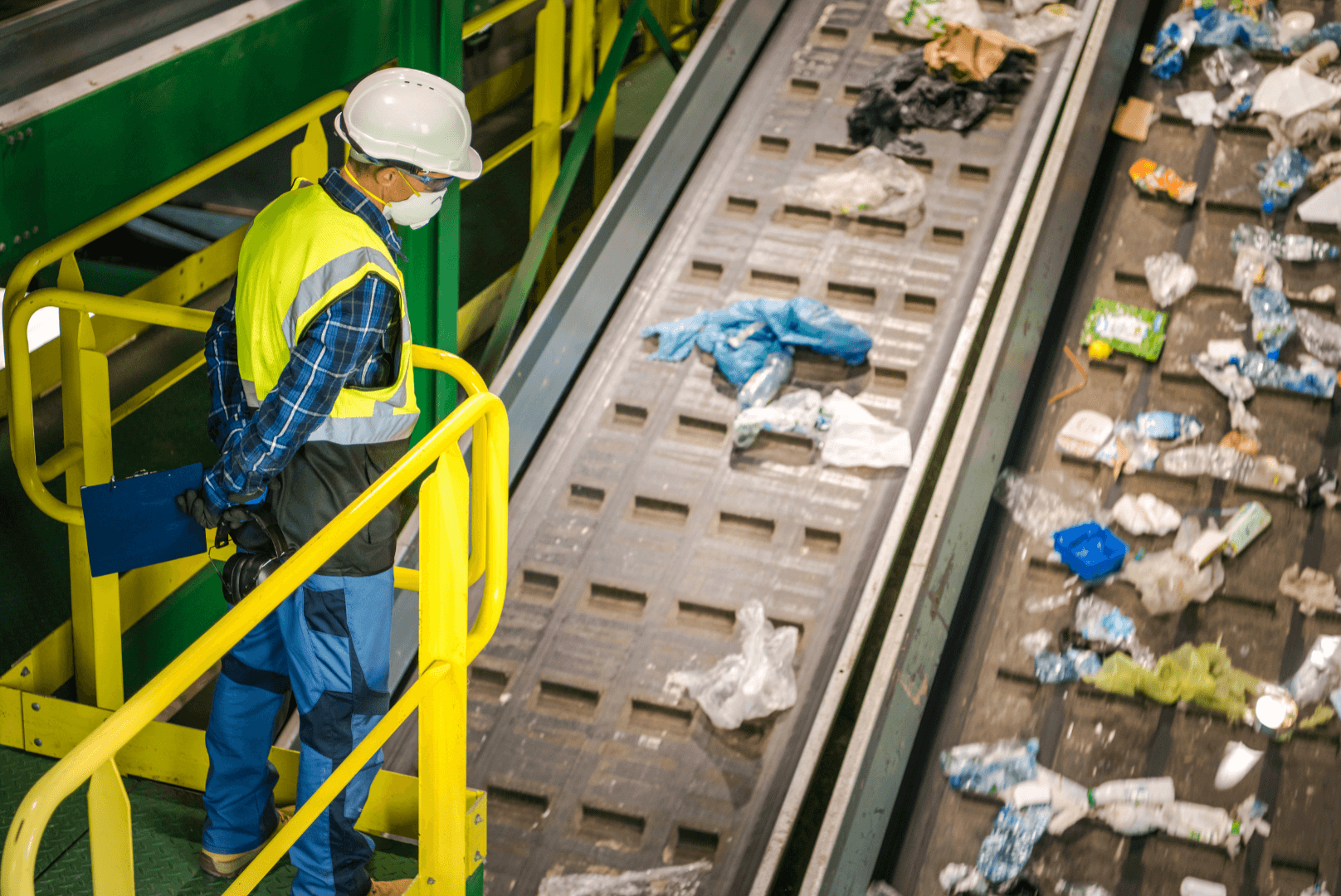
Casella recently renovated their Willimantic-based MRF with new technology for more effective and efficient sorting and processing to recover recyclables that have been discarded in the trash waste stream. Material inputs are processed both mechanically by machines and monitored manually by employees for quality control. Once processed, material is sorted into bales that will be delivered to customers that reuse these products in “end markets.”
A challenge facing facilities and the buyers of these end products is the amount of residue on the material. The residue rate of incoming recyclables is typically between 15%-20%. By the time it is sorted through this system, however, the number is drastically reduced to 1%, resulting in a much cleaner and more usable product for those who purchase these materials. The Casella MRF has the capacity to process 160,000 tons of single-stream recycling every year.
Ledyard Transfer Station Organics Collection
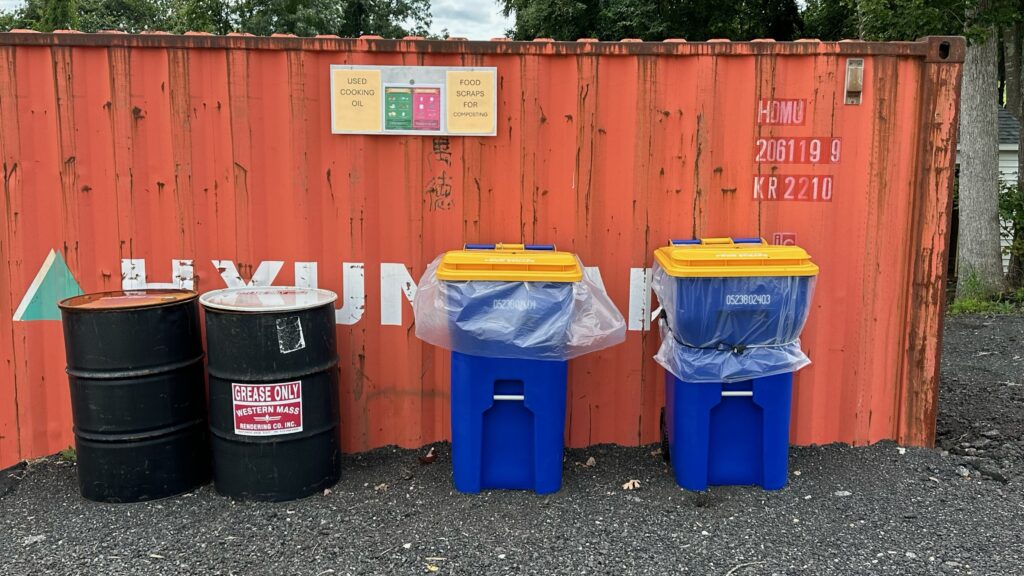
CT DEEP estimates that food scraps make up around 22% of the solid waste stream. Rich in moisture content, this material is heavy. Its weight puts heavier demands on trucks used to haul it, requiring heavier-duty vehicles and more fuel, increasing transportation cost factors in its disposal. In response to this reality and to the efforts of advocates, some municipalities have started implementing organics diversion programs.
Ledyard implemented a program in 2024 in which residents can bring food scraps to the transfer station for free. Collected in designated bins, the food scraps are then picked up by a private hauler that specializes in organics and taken to an appropriate processing facility. Material input for this program also comes from placing collection bins at the Ledyard Farmers Market.
Next Steps
The State of Connecticut has provided resources to support organic waste diversion through its solid waste Materials Management Infrastructure (MMI) and Sustainable Materials Management (SMM) grant programs.
SECOG, in partnership with the Town of Windham, was recently awarded funds from the MMI grant to purchase and install an in-vessel composter at the Town’s transfer station as well as implement a food scrap collection program at the public schools. SECOG looks forward to continuing to support our member towns with their efforts to reduce and divert waste.
Notice of 5/21 Public Open House
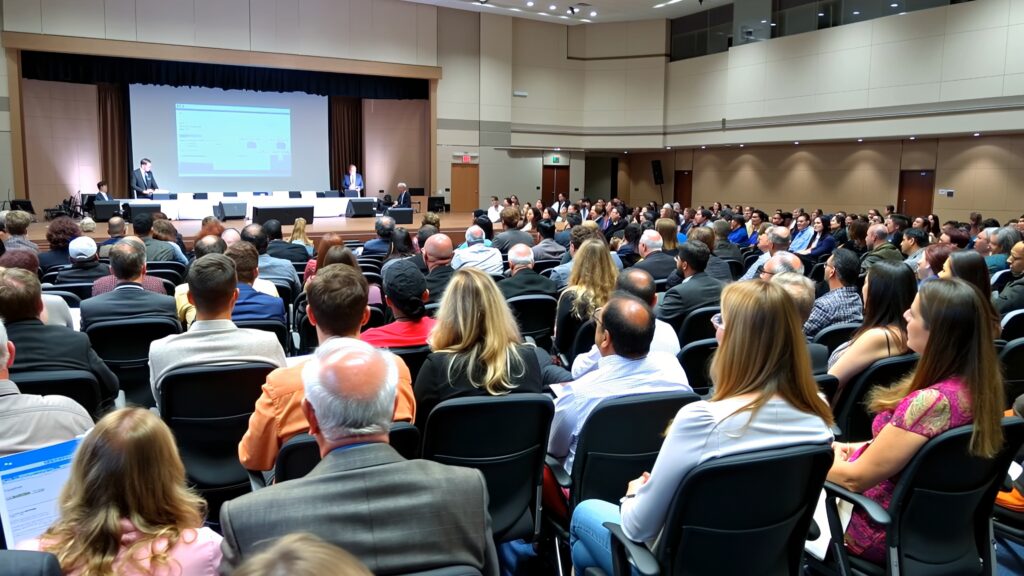
The Resilient Yantic River project team is hosting a public open house to discuss the results of initial flood mitigation option investigations along the Yantic River corridor. Residents of Norwich, Bozrah, and Franklin impacted by Yantic River flooding at home, on roadways, or otherwise are encouraged to attend to discuss potential flood risk reduction options and their anticipated benefits and trade-offs.
The event is open house style. Attendees are invited to drop in at any time within the 5:00pm -7:00pm timeframe to engage with project team staff around a corridor-wide view of flood challenges, a menu of flood mitigation options, a specific look at Town Street, and a specific look at the Upper Falls Dam area. There will be a formal project presentation at 6:00pm. The open house will be held at the Otis Library community room, located at 261 Main Street in Norwich, CT.
Request for qualifications
The Southeastern Connecticut Council of Governments (SECOG) is accepting consultant qualification proposals for the Local Transportation Capital Improvement Program (LOTCIP) professional engineering services. The firm selected will perform services to include application development assistance and professional design reviews for member municipalities.
Details are available at the Connecticut Department of Transportation’s LOTCIP website or may be obtained by contacting SECOG at (860) 889-2324.
Proposals should be submitted no later than April 30, 2025 at 3:30pm. Proposals will be accepted in writing to Debra Pierce, [email protected], or mailed to SECOG, 5 Connecticut Avenue, Norwich, CT 06360.
SECOG awarded grant from deep for composting infrastructure
We are very excited to announce that composting infrastructure will be on its way to the Town of Windham! SECOG was one of nine entities selected to receive grant funding from DEEP’s Materials Management Infrastructure Program.
Working closely with the Town and other community partners, the project will pilot municipal composting in Windham with an in-vessel composter at the transfer station and food scrap collection bins at schools and around town. SECOG worked closely with town officials, Eastern Connecticut State University, and CLiCK Inc to develop an application that reflected collaboration from government, nonprofit, and institutional partners.
Learn more about the grant and other recipients in this press release from DEEP. We look forward to sharing more details as the project unfolds.
SECOG legislative Agenda
On November 20th, 2024, the SECOG Board adopted priorities for 2025 legislative action, including state funding to stabilize the costs of special education, actions to promote a reduction in solid waste and the cost of municipal solid waste management, and reducing the expected municipal property tax burden of PA 24-46, which was intended to grant 100% property tax exemption to certain disabled veterans.
Testimony in support of SB 739 AN ACT CONCERNING THE DISTRIBUTION OF THE SALES AND USE TAXES IMPOSED ON MEALS SOLD BY AN EATING ESTABLISHMENT, CATERER OR GROCERY STORE
Testimony in support of HB 1281 AN ACT CONCERNING A STUDY ON THE NEED FOR EXTENDED PRODUCER
RESPONSIBILITY FOR SOLAR PANELS AND WIND TURBINE BLADES
Testimony in support of HB 5019 AN ACT ESTABLISHING EXTENDED PRODUCER RESPONSIBILITY FOR
CONSUMER BATTERIES
Testimony in support of HB 6917 AN ACT CONCERNING THE MANAGEMENT OF SOLID WASTE IN THE STATE
CTDOT SECTION 5310 GRANT PROGRAM – Funding Available
APPLICATIONS ARE DUE NO LATER THAN 4:00 PM ON TUESDAY, APRIL 1, 2025.
The Section 5310 program provides Federal funding for capital and operating expenses to improve mobility for seniors and individuals with disabilities.
For the current 2024 cycle, CTDOT will fund awarded Traditional vehicle projects at 80% federal share, with a 20% local match. Additionally, CTDOT will fund awarded Nontraditional projects at 50% or 80% share as funding allows and in accordance with budget language.
Eligible applicants include private nonprofit organizations, state/local government authorities, and operators of public transportation.
Application instructions, application types, and more information on the program can be found here: www.ct.gov/dot/5310
Request for Public Comment on the Public Participation and Consultation Process for Transportation Planning
Please be advised that a public notice will be printed in The Day newspaper on Saturday, the 1st of February, related to the SECOG 2025 Public Participation and Consultation Process for Transportation Planning.
SECOG prepares and maintains a public participation document, which sets forth the policies and practices that guide SECOG in seeking input from individuals and groups and describes the specific opportunities for public participation in the planning process. SECOG will hold a public comment period starting February 1, 2025, through March 17, 2025. The public is encouraged to participate in a public hearing held February 19, 2025, starting at 8:30am. The SECOG anticipates adoption of the finalized plan on March 19th, 2025, at the SECOG MPO meeting.
Members of the public may provide written and verbal comments in the following formats:
Letter mailed to: SECOG, 5 Connecticut Avenue, Norwich, CT 06360.
E-mail: [email protected]
Phone: 860-889-2324 ext. 120
In-Person: February 19th public hearing
2025 Draft Public Participation and Consultation Process for Transportation Planning
REQUEST FOR QUALIFICATIONS / PROPOSALS: SUBASE NEW LONDON COMPATIBLE USE PLAN
The Southeastern Connecticut Council of Governments (SECOG) is seeking qualifications and proposals from firms to prepare a Compatible Use Plan (CUP) for Submarine Base (SUBASE) New London and surrounding municipalities that expands and updates the 2017 SUBASE Joint Land Use Plan.
To complete the CUP, SECOG was awarded an Installation and Resilience Grant by the Office of Local Defense Community Cooperation, which provides funding for projects that increase collaboration between military installations and their host communities. Qualified firms will have experience in community planning, development and land use issues, and military installation management and operations. RFP submissions are due to Lana Melonakos-Harrison, Planner II, at [email protected], by February 7th, 2025 by 5:00 PM.
REQUEST FOR QUOTES: LOOPED NATURAL GAS SYSTEM PRELIMINARY PERMIT-LEVEL DESIGN AND ENGINEERING SERVICES
Note that quotes are due on November 26th by 4:00 PM. Please reach out to Helen Zincavage, Director of Regional Planning, at [email protected] with any questions on project details by November 19th.
SECOG, in partnership with Eversource and SUBASE New London, is seeking natural gas infrastructure design services to increase natural gas service resilience. Full project details are available in the Request for Quotes.